
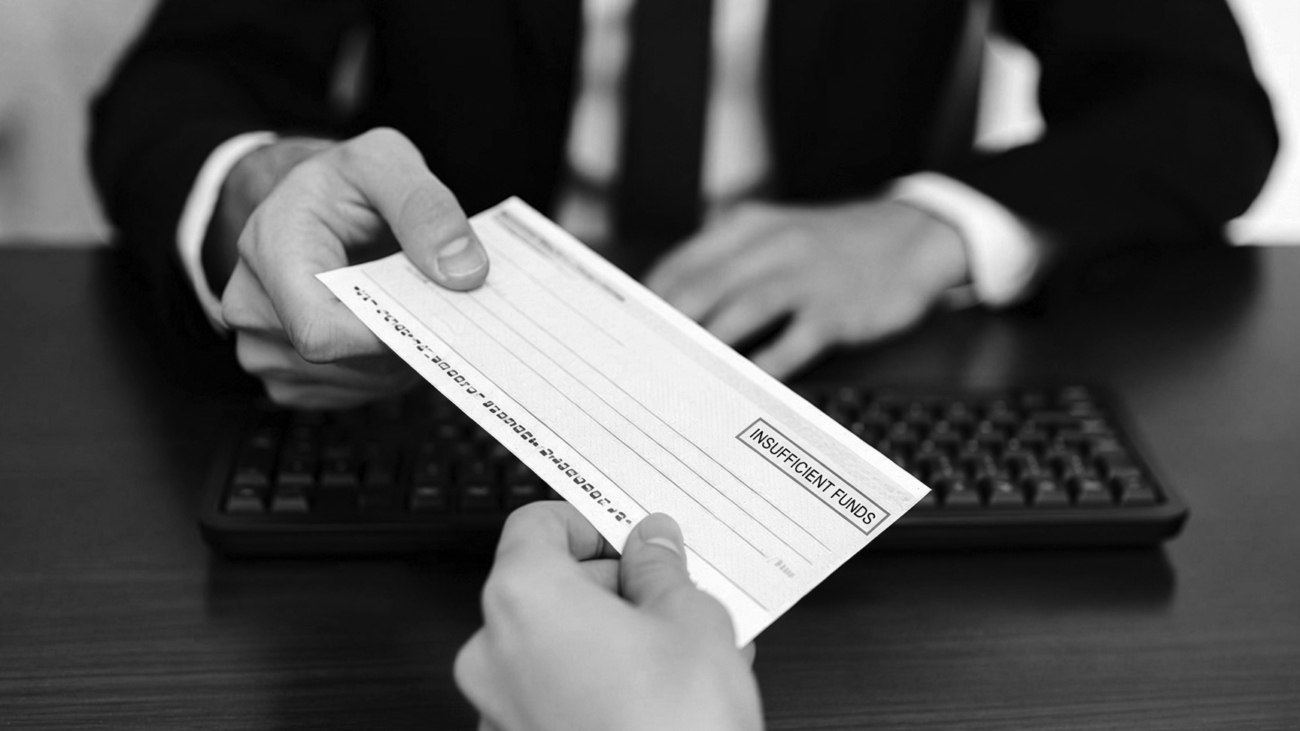
A cheque you were given for rent, for goods supplied or for the repayment of a loan has been returned unpaid by the bank. The practical question is what you can do about it and how quickly you can recover the money, and the answer under current UAE law is more favourable to the person holding the cheque than many people expect, although it is not the answer most people remember.
What Happens When a Cheque Bounces in the UAE?
Cheques are governed by Federal Decree-Law No. 50 of 2022 Promulgating the Commercial Transactions Law (the “Commercial Transactions Law”). When a bank refuses to pay a cheque, the holder is entitled to have the refusal recorded in a dated statement written on the cheque itself, and the bank may not decline to give it. That statement is the proof that the cheque was presented and not paid.
The person who issued the cheque guarantees its payment and cannot contract out of that guarantee. Accepting the cheque did not replace the debt it was meant to settle either, because the original debt remains in place, together with any security given for it, until the cheque is actually paid.
If the account holds only part of the amount, the bank must pay what is there unless the holder refuses, and return the cheque marked with the part payment so that the balance can still be pursued. The person who issued the cheque cannot stop payment by telling the bank not to pay. The bank must still pay unless the cheque was lost or the holder is bankrupt.
Is a Bounced Cheque Still a Crime in the UAE?
Since January 2022, the law reserves criminal penalties for specific acts of bad faith. A cheque returned simply because the account was short of funds is instead dealt with as a debt, which the holder can enforce directly through the execution court. What remains criminal under the Commercial Transactions Law is acting in bad faith to prevent a cheque from being paid, which includes:
Stopping the chequeInstructing the bank, before the date of the cheque, not to pay it, other than because the cheque has been lost or the holder has become bankrupt.
Emptying or closing the accountClosing the account or withdrawing the whole balance, issuing or presenting a cheque on an account known to be closed, or deliberately causing the account to be frozen.
Writing a cheque that cannot be cashedIntentionally writing or signing the cheque in a way that prevents payment.
These bad-faith offences, unlike a cheque that is simply returned for lack of funds, carry imprisonment of between six months and two years, a fine of at least 10% of the value of the cheque (with a minimum of AED 5,000/-) and up to double its value, or both. Forging a cheque, or knowingly using a forged one, is punished more heavily. Where the cheque was issued in the name of a company, the person managing it is punished only if he or she knew of the offence or committed it for a personal or third-party interest, and otherwise it is the company that is fined.
For the person owed the money, a criminal complaint does not prevent the cheque from being enforced through the courts at the same time, and the criminal case comes to an end if the cheque is paid or the parties settle before a final judgment; a settlement reached after that suspends the sentence. A complaint is therefore a source of pressure in the right case, but it is not in itself the route to recovery.
How Do I Recover the Money on a Bounced Cheque?
The most significant feature of the current law is that the holder of a bounced cheque does not need to file a case and wait for a judgment. Once the bank has recorded on the cheque that it was returned for insufficient or no balance, or because the account has been closed, the cheque itself is treated as an executive document, in the same way as a court judgment. The courts had taken different views on closed accounts until the Federal Supreme Court’s Judicial Principles Unification Authority settled the point, in a decision announced in January 2024, that a closed account is treated the same as one with no funds. The holder can apply directly to the execution court to enforce it, whether for the whole amount or for the part left unpaid.
The holder of a bounced cheque does not need to file a case and wait for a judgment.
The enforcement itself is governed by Federal Decree-Law No. 42 of 2022 Promulgating the Civil Procedure Law (the “Civil Procedure Law”). The debtor is served with the cheque and given seven days to pay, after which the court can move against the debtor’s assets, including money held in bank accounts.
Where the cheque was returned for another reason, such as a signature that does not match the bank’s records, the direct route is not available on the wording of the law, and recovery is pursued through a claim before the courts on the cheque and the debt behind it.
Can the Debtor Be Stopped from Leaving the UAE?
The Civil Procedure Law allows a creditor to apply for a travel ban, even before a case is filed, where there are serious reasons to fear that the debtor will leave the country and the debt is not less than AED 10,000/-. Within an execution file, the Execution Judge may also order a travel ban, or the attachment of assets, before the debtor is even served, where there are indications that the debtor is seeking to leave or to move assets out of reach.
A debtor who fails to comply with an execution order may, on the creditor’s application, be detained unless he or she proves an inability to pay. None of these measures is automatic, as each is a decision of the court on the evidence put before it.
What Should You Do Now?
If you are holding the cheque:
Keep the original cheque and the bank’s statementThese two documents are the basis of the enforcement application, and neither should be handed back to the debtor.
Act promptlyA cheque cannot be presented before the date written on it and must be presented within six months of that date. Delay after it is returned also gives the debtor time to move assets or to leave the UAE.
Be cautious about replacement chequesExchanging a returned cheque for a new one gives up a document that can be enforced today in return for one that may also be returned.
Take advice before filing a criminal complaintA complaint is available only in the cases described above, and the right course depends on why the cheque was returned and who signed it.
If you issued the cheque:
Do not stop the cheque or close the accountA cheque returned for lack of funds is a civil matter, but instructing the bank not to pay it, or emptying or closing the account, is an offence that carries imprisonment, and closing the account will not stop the cheque being enforced against you.
Deal with it earlyPaying the cheque or reaching a settlement brings a criminal case to an end if it is done before a final judgment, and it is far easier to negotiate before enforcement has begun.
Do not ignore a notice from the courtOnce the cheque is filed for enforcement you have seven days from being served to pay, after which your assets can be attached and a travel ban can follow.
We act for both creditors and debtors in bounced cheque matters, from the first demand or settlement discussion through to enforcement before the courts.
Lionel A. Sequeira is a Legal Consultant – Intellectual Property & Commercial at Al Midfa & Associates.
At Al Midfa & Associates, we offer comprehensive services tailored to meet your needs, ensuring that your rights are protected at every step of the way. Please feel free to contact us.