
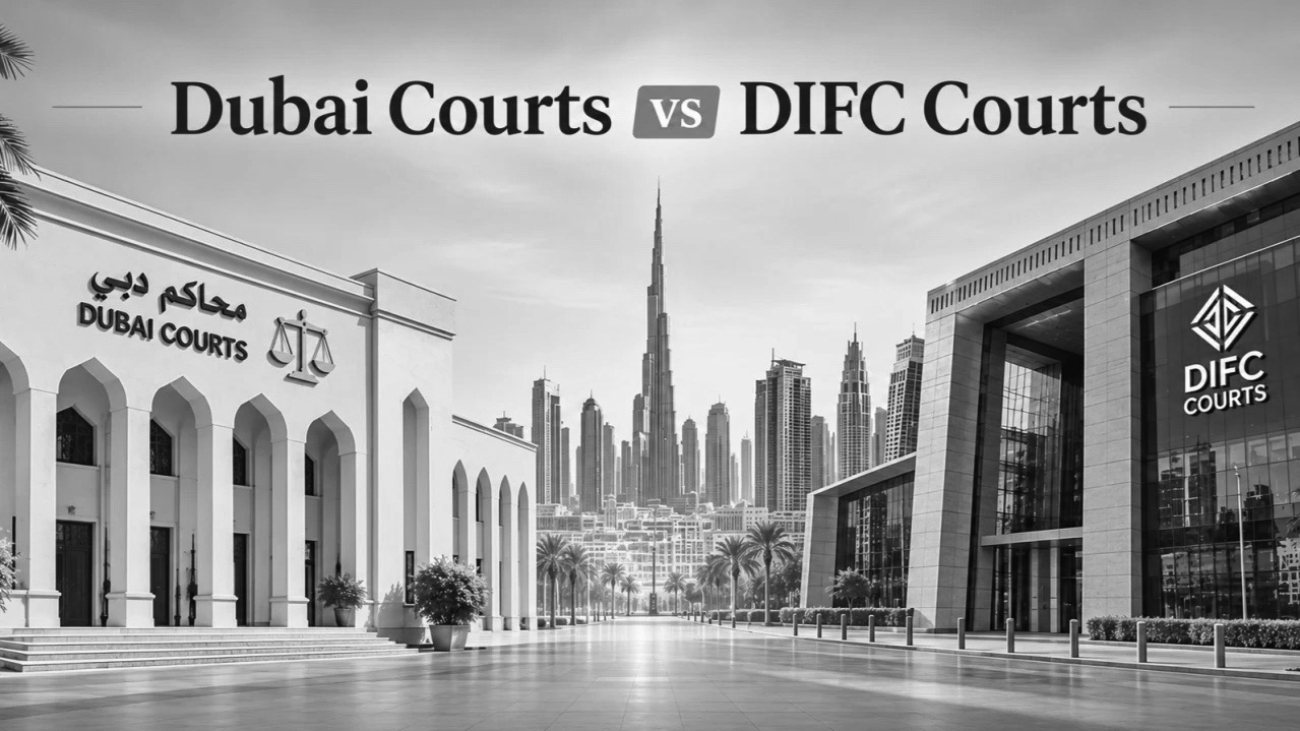
The jurisdiction clause in a commercial agreement is often treated as standard boilerplate. In a high-value dispute, it can become one of the most consequential provisions in the entire contract.
Let’s understand this from a real-world scenario. Imagine an international investor executing a substantial investment into a UAE free zone company. The parties negotiate extensively over investment amounts, shareholder protections, management rights, warranties, indemnities and exit arrangements and buried towards the end is a familiar clause that provides the usual: governing law of the agreement shall be the laws of the UAE and the courts of Dubai shall have exclusive jurisdiction. The parties of course sign without giving the clause much attention, but the same clause becomes the most important consideration when one of the parties alleges a breach of contractual obligations, misrepresentation and diversion of business opportunities. The dispute involves substantial financial claims, complex documentary evidence and parties operating from different jurisdictions, with different legal mindset. Only then do the parties begin considering whether the Dubai Courts or the DIFC Courts would have been the more appropriate forum.
This imaginary scenario brings forth an important principle in commercial contracting: the choice of jurisdiction is not merely a procedural formality. It is a strategic commercial decision.
The choice of jurisdiction is not merely a procedural formality. It is a strategic commercial decision.
Two Judicial Systems Within Dubai
Dubai offers businesses access to two distinct judicial systems: the Dubai Courts and the Courts of the Dubai International Financial Centre (“DIFC”). Both operate within the Emirate of Dubai, but their legal frameworks, procedural approaches and institutional characteristics differ significantly.
While Dubai Courts operate within the UAE’s civil-law judicial framework, DIFC Courts function within a common-law judicial framework. The proceedings in Dubai Courts are conducted in Arabic, while the official language of DIFC Courts is English. Dubai Courts apply the relevant UAE federal and local legislation, while DIFC Courts have their own set of laws, rules and regulations based on common law principles. Another significant difference lies in how commercial disputes are handled by the two courts. In Dubai Courts, commercial disputes are ordinarily determined through procedures involving written submissions, documentary evidence and, where necessary, court-appointed experts. In the DIFC Courts, on the other hand, proceedings may involve extensive documentary disclosure, witness statements, oral testimony, cross-examination and interim applications.
| Dubai Courts | DIFC Courts | |
|---|---|---|
| Legal framework | UAE civil-law judicial framework | Common-law judicial framework |
| Language | Arabic | English |
| Law applied | Relevant UAE federal and local legislation | Own laws, rules and regulations based on common law principles |
| Commercial procedure | Written submissions, documentary evidence and, where necessary, court-appointed experts | Documentary disclosure, witness statements, oral testimony, cross-examination and interim applications |
So, the question here is, whether businesses have the freedom to choose one of the two judicial systems and whether DIFC Courts can be chosen as a natural jurisdiction for any dispute. Generally speaking, for businesses whose operations, contractual relationships and assets are predominantly situated in mainland Dubai, the Dubai Courts may be a natural and commercially appropriate forum, but even though the DIFC Courts are not automatically the appropriate forum, there may be a possibility of selecting DIFC Courts as an exclusive forum to adjudicate all commercial disputes arising out contractual relationships. Let’s look at the legal basis for making such a choice.
Dubai Law No. 2 of 2025
An important development in this area is Dubai Law No. 2 of 2025 concerning the DIFC Courts (“DIFC Law”). Article 14 of the DIFC Law sets out the jurisdiction of the DIFC Courts, including jurisdiction arising from specified DIFC connections and jurisdiction based on the parties’ express written agreement. Of particular relevance to commercial contracting is Article 14(b), which recognises the DIFC Courts’ jurisdiction over civil and commercial claims where the parties expressly agree in writing to submit their disputes to those courts. Such an agreement may be made before or after a dispute arises, provided the jurisdiction agreement is specific, clear and express.
This means that, for civil and commercial disputes, parties conducting business even outside the DIFC may still agree to have their disputes determined by the DIFC Courts. For international businesses investing in Dubai, this becomes an important consideration, as they can agree to adjudicate disputes in a judicial system which operates in a familiar language and applies a more familiar common law framework.
Now one may ask, if parties choose DIFC Courts as jurisdiction for adjudicating their disputes, does that mean that the courts will apply DIFC laws to such disputes even though both the parties may be outside DIFC? To answer this question, we need to understand the basic principle: Jurisdiction and Governing Law Are Not the Same Thing.
Jurisdiction and Governing Law Are Not the Same Thing
In my practice, one of the most common and at the same time one of the most easy to make drafting mistakes in international commercial agreements is treating governing law and jurisdiction as interchangeable concepts. The two have absolutely different meaning and one must deal with both the subjects in detail in any given contract.
While jurisdiction means the court or the forum authorised to determine and adjudicate disputes, governing law means the substantive legal principles applicable to the contractual relationship and, therefore, the dispute in question.
For instance, the parties may agree that their contract is governed by federal UAE law with DIFC Courts having exclusive jurisdiction. This would mean that any dispute will be brought to DIFC Courts, but the Courts will apply the legal principles of federal UAE law. Similarly, the parties may choose DIFC law as the governing law of their agreement, and DIFC Courts as the jurisdiction.
Choosing DIFC Courts as the forum does not necessarily guarantee application of DIFC laws and at the same time the opposite is also not true, that is, selecting DIFC law does not automatically establish DIFC Courts’ jurisdiction.
Article 23 of DIFC Law while addressing this issue provides that the courts of DIFC shall apply DIFC laws and regulations except when: (i) DIFC laws and regulations provide otherwise; or (ii) where the parties have expressly agreed that another law shall govern their dispute.
So, in short, in cases where the contracts are silent on governing law matters, DIFC Courts will apply DIFC laws and regulations unless the said laws themselves prevent such application or if the parties have agreed for another law as the governing law. This in other words mean, a carefully and properly drafted contract must address both the matters.
DIFC Courts or Dubai Courts?
Having discussed the distinction between jurisdiction, governing law, DIFC and Dubai Courts functioning, one may ask, how can we determine which jurisdiction or governing law is a better choice for our particular case. To be honest, there is no simple answer to this question; neither system should be assumed to be inherently superior over the other.
The relevant question one must ask is which framework is better suited to the anticipated nature of the dispute.
The choice of court can materially influence how a dispute is handled, how evidence is presented and examined. In mainland UAE litigation, court-appointed experts frequently play an important role in technical and financial disputes. In the DIFC Courts, however, the procedural framework provides for disclosure, witness evidence and expert testimony in accordance with the applicable court rules and directions. When determining which judicial system better suits a particular matter, businesses and legal advisors drafting these documents should look at the circumstances and details of the matter. For instance,
Payment recoveryA straightforward payment recovery claim may not require extensive documentary disclosure, which can be managed at any of the forums.
Acquisition disputeA complex acquisition dispute may involve thousands of documents and multiple factual witnesses. For situations like these DIFC Courts may be a better forum.
Construction disputeA construction dispute may depend heavily on technical expert evidence.
Shareholder disputeA shareholder dispute may involve allegations requiring detailed examination of communications, management decisions and financial records.
A careful examination of considerations as above should generally be able to help determine whether DIFC Courts would be a better forum or should parties opt for Dubai Courts.
NOTE: It is however pertinent to mention that choice of a particular forum may not necessarily mean a different outcome of the dispute. It may simply mean in most of the cases that the dispute might proceed through a different procedural framework and the manner in which the dispute is prepared, presented and adjudicated could differ materially.
Another careful consideration that one must always bear in mind is execution and implementation of the judgment. Winning a judgment is not the same as recovering money. Therefore, a commercially successful litigation strategy must consider enforcement from the outset. For instance, a claimant obtains a substantial monetary judgment against a defendant whose principal assets are located in mainland Dubai. If the judgment was issued by the DIFC Courts, enforcement outside the DIFC may require the applicable coordination and execution procedures. As provided under Article 32 of DIFC Law, there are certain procedural requirements for enforcement of DIFC-issued judgments where subject matter of enforcement is located outside the DIFC. Such requirements include, among other things, finality and enforceability, an official Arabic translation, the appropriate executory formula, a formal request and payment of applicable fees.
In view of the foregoing, while determining the appropriate forum for a subject matter, the parties must consider:
Where are the counterparty’s assets located?
Will a judgment require enforcement outside the issuing court’s jurisdiction?
Are interim protective measures available?
Does the counterparty have assets in multiple countries?
Are there likely to be competing proceedings or jurisdictional objections?
The answers may materially influence the choice of forum.
Hence, drafting a dispute resolution clause is not that simple after all! Poorly drafted dispute resolution clauses can create uncertainty over which court should hear a dispute.
For example, I recently came across an agreement, where there was a vaguely worded arbitration clause, governing law provision referred to both UAE and DIFC Law and the jurisdiction was Dubai Courts. The matter went through a successful judgment at the Court of First Instance, but on appeal, the Court sent the matter to arbitration, however, the arbitration forum also refused to accept the matter as the arbitration clause was drafted vaguely and contained inconsistencies.
Therefore, parties must draft this particular clause carefully so as to minimise risks of dismissal and non-admissibility of disputes by using clear and consistent jurisdiction and governing law provisions.
Conclusion
Although, as can be seen from the above, there is no universal answer to the question as to which jurisdiction should be chosen by businesses or who wins the battle Dubai Courts vs. DIFC Courts. The answer as can be seen depends on several factors carefully considered before finally determining your preferred jurisdiction and forum.
Dubai Courts may be particularly appropriate where the dispute is closely connected to mainland UAE operations, the relevant contracts are governed by UAE law, and the parties and evidence are predominantly located within the jurisdiction. The DIFC Courts, on the other hand, may be attractive for certain international commercial disputes where parties prefer English-language proceedings and a common-law procedural framework.
However, factors such as litigation costs, procedural complexity, jurisdictional requirements, governing law and enforcement must be assessed in each case.
Commercial contracts are generally negotiated with the expectation that the parties will perform their obligations. However, sophisticated contracting requires parties to consider what happens when that expectation is not fulfilled. The choice between Dubai Courts, DIFC Courts and arbitration can affect the procedural framework, evidence, litigation strategy, costs and enforcement options available to the parties.
Disclaimer: This article is intended for general information and does not constitute legal advice.
Karteekka Tyaggi is a Senior Legal Consultant – Head of Corporate Law at Al Midfa & Associates.
At Al Midfa & Associates, we offer comprehensive services tailored to meet your needs, ensuring that your rights are protected at every step of the way. Please feel free to contact us.